
The criteria live in documents
Policies, operating standards and contract terms sit in a document repository. Half of every answer is finding and reading that document.
Whatever must be masked stays masked wherever the query runs. When you outgrow it, PAASUP DIP takes over.
After the consultation we run a PoC on one data source.
Pilots mostly succeed. The moment you widen them, it stops at who may see what. Permissions, sensitive data and scattered sources arrive at once, and the industry is stalling in the same place.
Failures are most likely to occur when organizations fail to distinguish between an agent's ability to act and the scope of access it is granted. By 2027, 40% of enterprises will demote or decommission autonomous AI agents due to governance gaps.
By 2027, 60% of organizations that ignore data governance culture challenges will fail to govern AI successfully.
Writing a policy and making that policy actually apply on every read path are two different jobs. PAASUP DNA takes the second one.
If those three live in three different tools, each path returns a different answer.
People and AI agents pass the same gate. What something may do and what it may see are set separately.
Rather than blocking it, let people use it masked. The policy applies at read time and the original is untouched.
Criteria live in documents, numbers live in the database. Analysis only becomes routine when the asker need not know which.
Policies, operating standards and contract terms sit in a document repository. Half of every answer is finding and reading that document.
How many, how much, right now: that is in the database. Getting the number means going through someone who writes SQL.
When each system masks personal data its own way, the same person sees different values depending on the path they took.
Document repository, data catalog and de-identification policy live in one environment. The person asking does not need to know which system holds the answer.
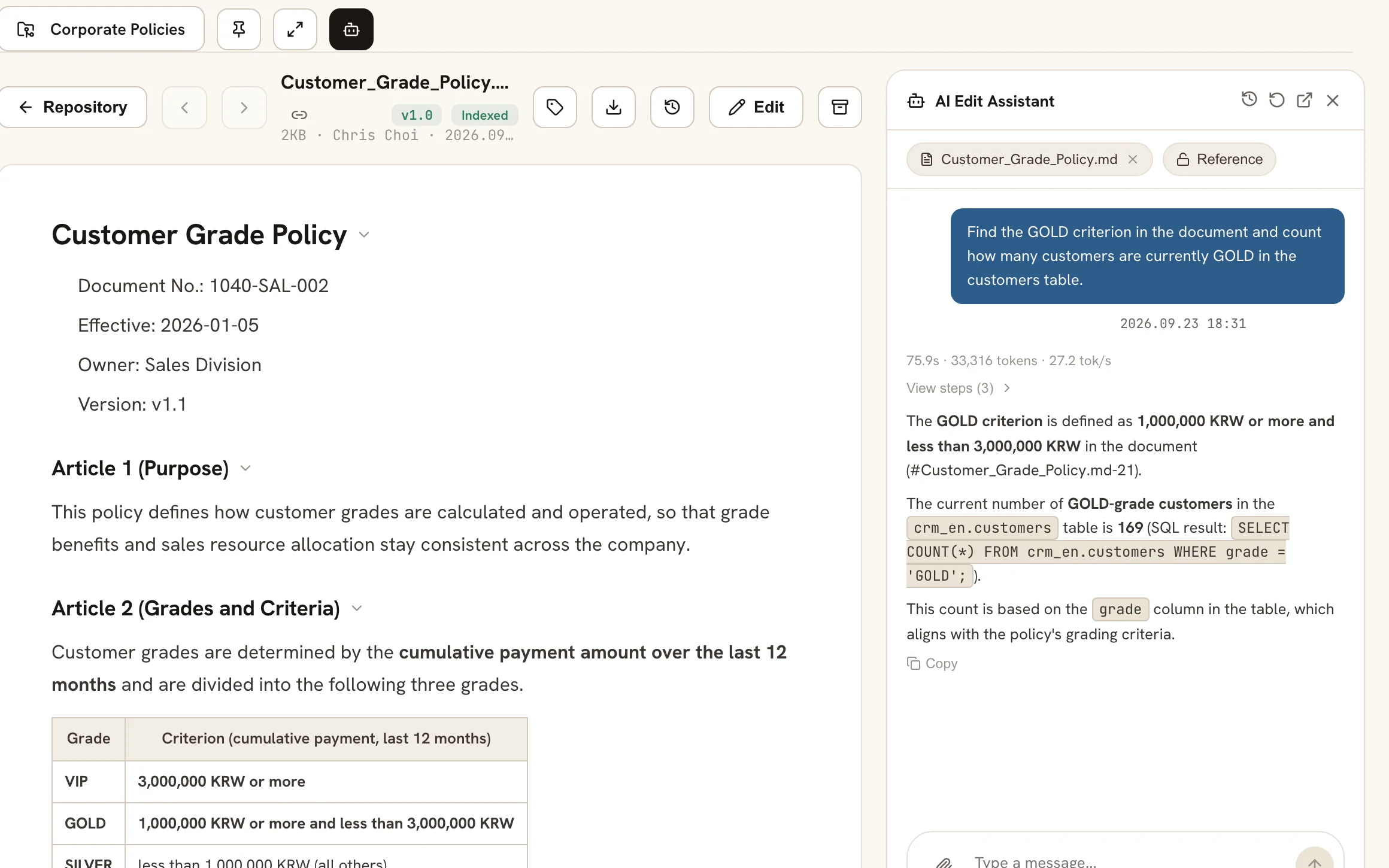
Documents, unstructured and structured data live in one repository, one catalog, one question box. One question gets an answer from documents and the database together, with the source file name, page and the SQL that ran.
Personal data is masked at read time by a policy set once. Document queries and SQL results fall under the same policy. The original is never touched.
Viewing, search, SQL and ETL all pass through the same permission gate. Run the same query as two users with different permissions and different values get masked.
Captured on a demo tenant. All personal data is fictitious.
The criterion from the document, the current figure from the table. One answer carries the source file name, page and the SQL that ran.
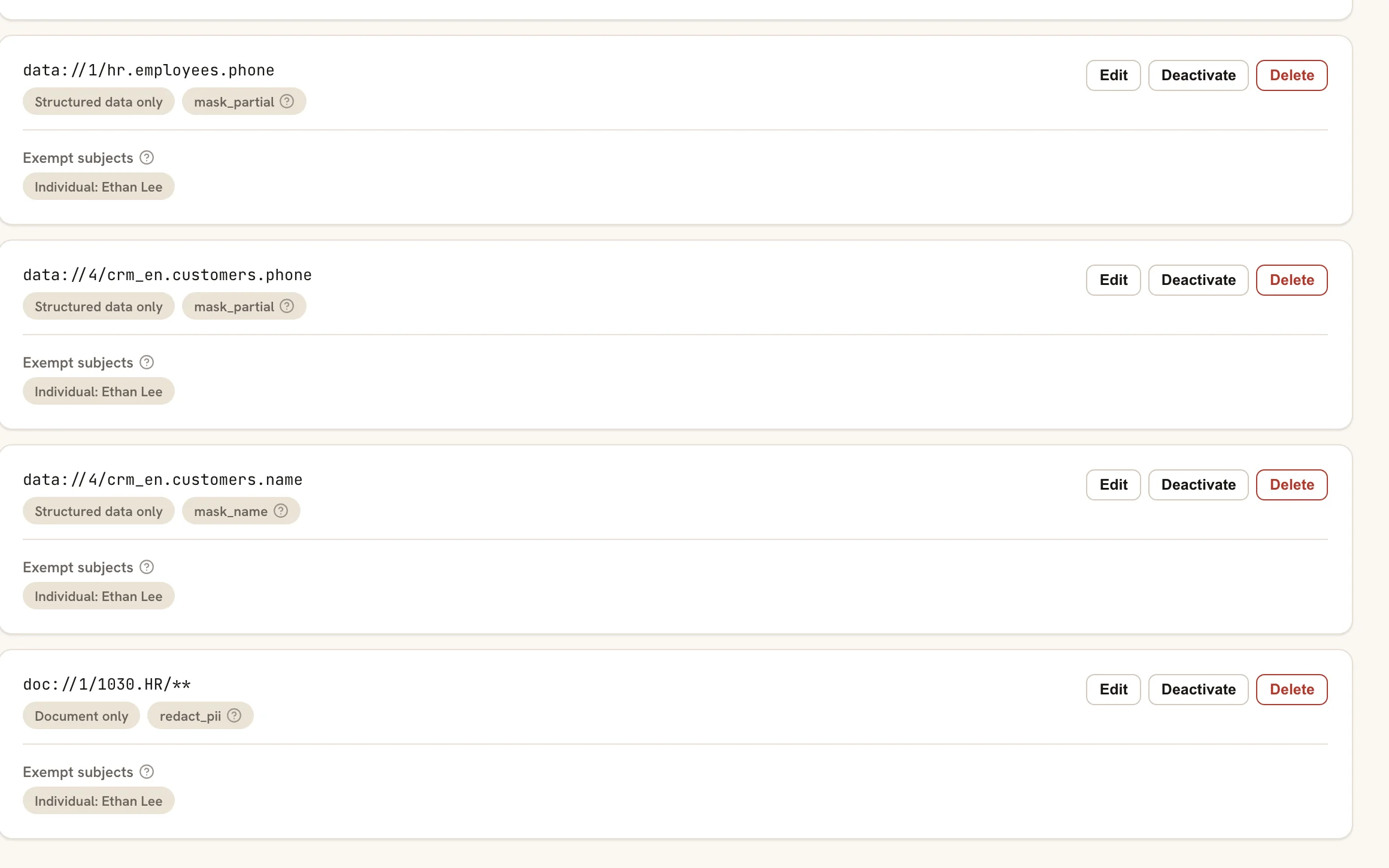
doc:// document paths and data:// table columns share one de-identification policy. Exceptions only for named subjects. Anyone who is not an exempt subject sees masked values only.
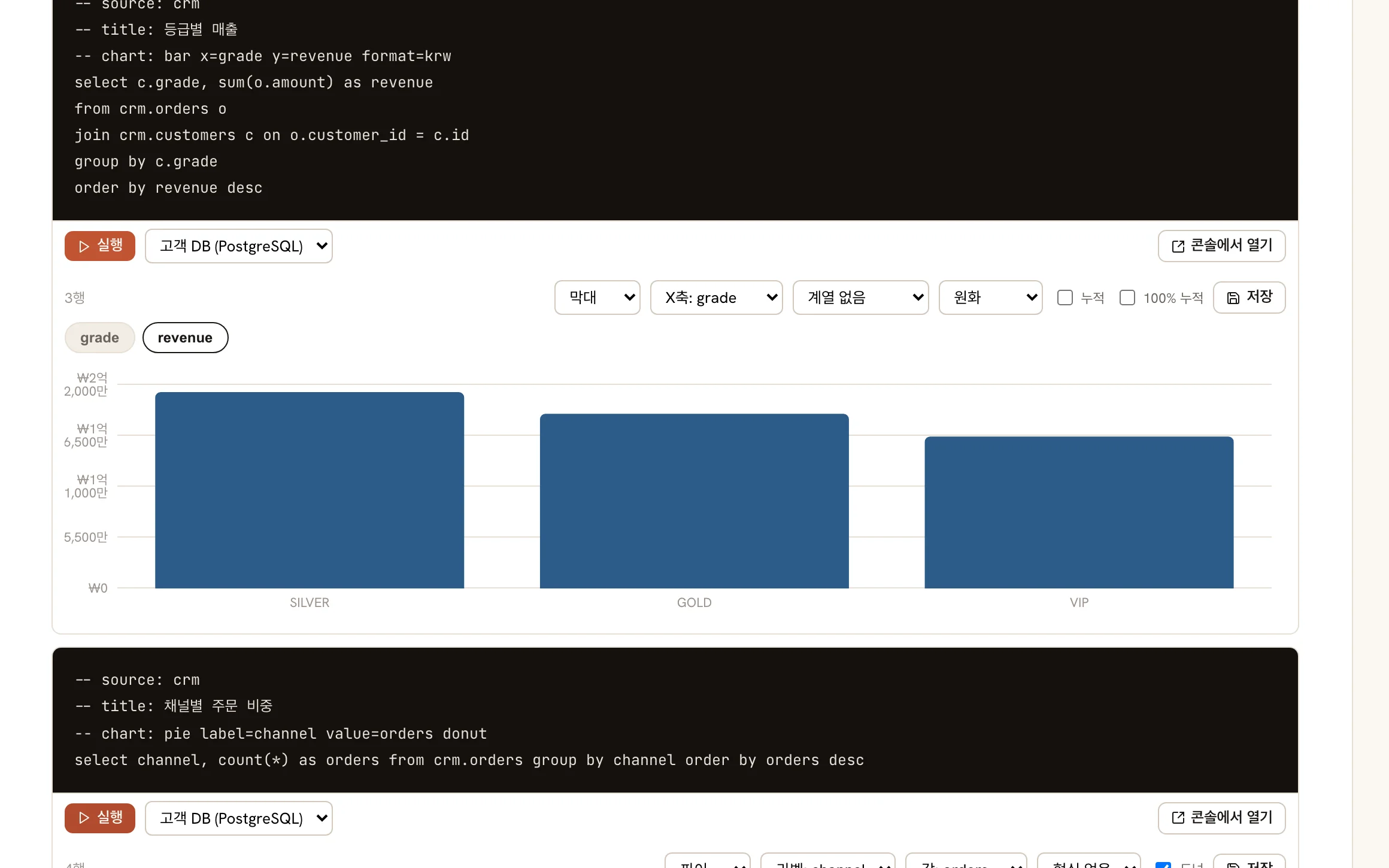
Several SQL cells in one document, each rendered as a different chart (line, bar, pie). Switch chart types per cell and try them out.
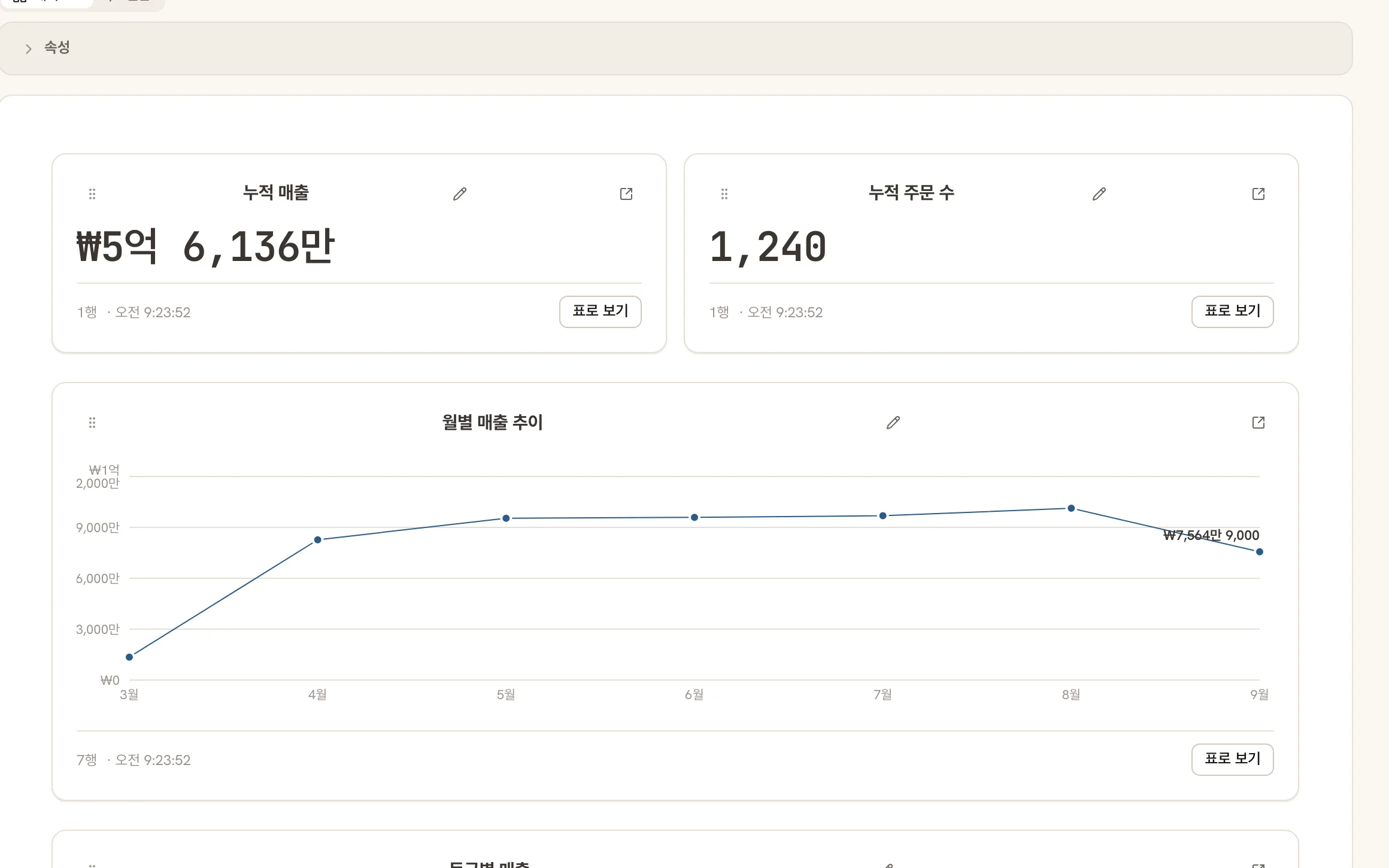
The same data laid out as KPI, trend, comparison and share cards in one dashboard document. The document itself is the dashboard.
Batch, virtualization, streaming and LLM serving move to the platform below, and permissions and policy carry down as is. Who can see what does not change. See PAASUP DIP
We pick one data source and one document repository.
Run the same question under two permission sets within that scope. That is where the PoC ends.
Add sources and repositories as you need them. Permissions and policy follow the same way.
Anything that depends on your environment is answered in the consultation.
Share the questions you ask often and where their answers live in documents and data. We will reply with a scoped PoC.